In the span of just three weeks, the global oil market has swung from a historic surplus to a geopolitical crisis that the International Energy Agency has called "the largest disruption to global energy supplies in history." For industries that run on oil — and the filtration systems that keep that oil clean — the reverberations are profound, immediate, and far-reaching.
What Is Putting Global Oil Supply Under Pressure in 2026?
The story of global oil supply in 2026 is one of extreme paradox: the year began with one of the largest structural oil surpluses in modern history, only to be upended by an unprecedented geopolitical shock within weeks. Understanding both dynamics is critical for anyone operating in the energy value chain.
The Strait of Hormuz Crisis
On February 28, 2026, the United States and Israel launched joint military strikes on Iran. The immediate consequence was devastating for global oil markets: Iran effectively closed the Strait of Hormuz to most shipping traffic. The Strait is responsible for transporting roughly one-fifth of the world's oil supply — approximately 20 million barrels per day under normal conditions.
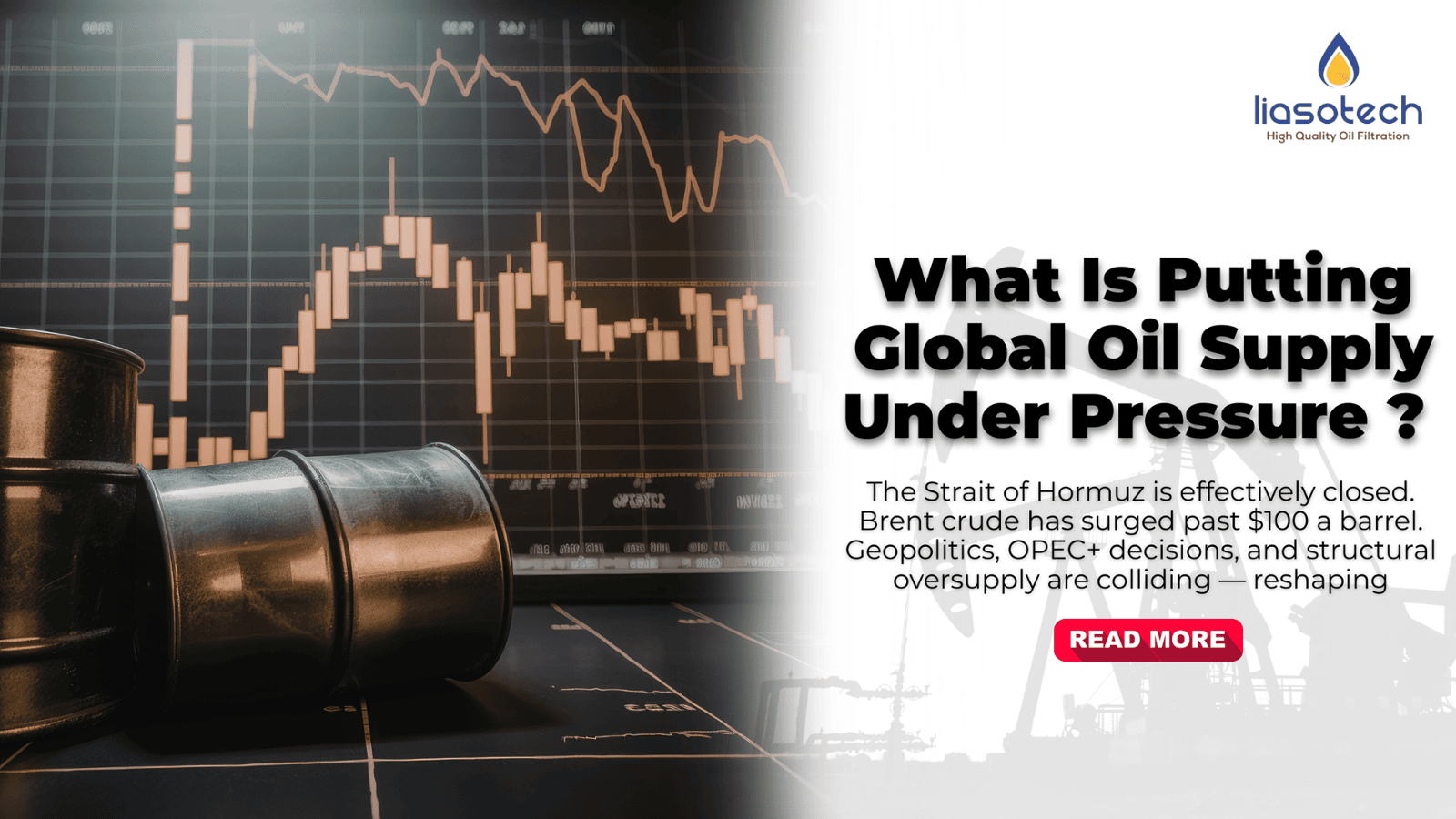
Brent crude, the world's most important oil benchmark, rose as much as 3 percent on March 16 to top $106 a barrel, before easing slightly. Brent stood at $104.63 a barrel as of early trading, with prices continuing to rise as markets saw no end in sight to the effective closure of the Strait.
Hundreds of tankers sat idle on both sides of the Strait as Iran brought shipping to a standstill, pushing oil prices above $100 per barrel for the first time since the Russia-Ukraine war began in 2022. Disruptions to Middle Eastern supplies due to attacks on the region's oil infrastructure and the cessation of tanker traffic sent Brent futures soaring to within a whisker of $120 per barrel at peak anxiety.
The Pre-Crisis Surplus: A Market Already Under Strain
Before the conflict, global oil markets were navigating a very different kind of pressure — oversupply. A historic surplus averaging 1.2 million barrels per day had fundamentally broken the decades-long cycle of price volatility and supply anxiety. This structural oversupply, the largest since the 2020 pandemic lockdowns, had sent Brent crude tumbling to a five-year low of around $60 per barrel. The primary driver was a relentless production surge from the "Americas Quintet" — the United States, Brazil, Canada, Guyana, and Argentina.
The Brent crude oil spot price had risen from an average of $71 per barrel on February 27 to $94 per barrel on March 9, following the onset of military action in the Middle East. The primary risk that would cause oil prices to continue rising is an extended closure of the Strait of Hormuz, a major world oil transit chokepoint through which nearly 20% of global oil supply flows.
The closure of the Strait of Hormuz added roughly $40 per barrel as a geopolitical risk premium above what market fundamentals would normally dictate.
— Nabil al-Marsoumi, Oil Market Expert, via Al Jazeera
The IEA Emergency Response
IEA member countries unanimously agreed on March 11 to make 400 million barrels of oil from their emergency reserves available to the market to address disruptions stemming from the war in the Middle East. Global oil supply is projected to plunge by 8 mb/d in March, with curtailments in the Middle East only partly offset by higher output from non-OPEC+ producers. More than 3 mb/d of refining capacity in the region has already shut due to attacks and a lack of viable export outlets.
Emergency reserves can calm panic in markets but cannot replace the lost function of a disrupted shipping corridor. The release may soften the shock and calm nerves temporarily, but it will remain limited as long as the fundamental problem — the freedom of supply and tanker movement through Hormuz.
How the Oil Sector Is Being Impacted
The oil sector is experiencing the full spectrum of pressure: upstream producers are grappling with price volatility that makes new drilling decisions extraordinarily difficult, midstream operators face rerouted trade flows and idle infrastructure, and downstream refiners are confronting a shortage of feedstock as Middle East refinery capacity has been shut in.
Upstream Producers
Price volatility between $60 and $120 per barrel within weeks makes capital planning nearly impossible. Companies in the Americas continue drilling for anticipated long-term recovery, but smaller upstream operators face breakeven crises at lower price points.
Midstream & Logistics
Hundreds of tankers lie idle at the Strait of Hormuz. Trade flows are being fundamentally rerouted — Russian crude away from India toward China, Gulf barrels unable to reach Asian markets. Shipping costs and insurance premiums have surged.
Downstream Refiners
Over 3 mb/d of Middle Eastern refining capacity has been shut. Gulf producers have declared force majeure. Refiners elsewhere face feedstock shortages, forcing run cuts and squeezing product margins in an already compressed market.
National Oil Companies
QatarEnergy, Kuwait Petroleum Corporation, Bapco, and others have shut production and declared force majeure. Saudi Aramco and ADNOC have shuttered refineries, removing millions of barrels from global refining capacity in a matter of days.
OPEC+ in a Delicate Position
On March 1, OPEC+ agreed to begin increasing production in April 2026 by a total of 206,000 barrels per day in response to estimated low oil inventories, with the next decision due on April 5. The assumption around OPEC+ supply is contingent on the duration and extent of disruption to oil flows around the Strait of Hormuz.
Sanctions on Russian oil are reshaping global trade flows, with barrels being redirected away from India and primarily toward China. India's partial pullback from Russian crude — amounting to a loss of 600 to 800 thousand barrels per day — is being offset by increased shipments to China, where Russian crude imports have risen by 0.5 million barrels per day, with independent refiners and storage facilities providing flexibility to absorb these discounted barrels.
The Outlook: Volatility Is the New Normal
Oil may remain both elevated and volatile through the end of 2026. Hostilities in the Middle East don't look to be coming to an end soon, and stabilized oil markets may require an unlikely peaceful power transition in Iran. The CBOE Volatility Index recently exceeded 29 and remains near 25, above the threshold of 20 that indicates rising investor fear and volatility.
Energy companies face mounting pressure to protect margins and manage risk. Oil exploration and production companies and oil field services providers may be on the front lines of any oil price squeeze. Companies across the value chain are feeling the effects, both positive and negative.
Impact on the Oil Filtration Industry
The oil filtration sector sits at a unique intersection of the crisis: it is simultaneously a supplier to the oil industry and a casualty of the same disruptions. The sector faces cost pressures, supply chain dislocations, and surging demand signals — all at once.
A Growing Market Already Under Structural Shift
Even before the 2026 crisis, the oil filtration market was on a strong growth trajectory. The Oil Filter Market grew from USD 3.18 billion in 2025 to USD 3.39 billion in 2026, and is expected to continue growing at a CAGR of 6.74%, reaching USD 5.02 billion by 2032. The oil filter sector sits at the intersection of automotive engineering, aftermarket services, supply chain resilience, and regulatory scrutiny.
Supply Chain Disruption
Filtration manufacturers source components globally. With Middle Eastern shipping routes disrupted and tariff pressures rising, raw material costs for filter media, housings, and subassemblies are climbing. Lead times are extending across the board.
Nearshoring & Dual Sourcing
Cumulative tariff adjustments on imported filtration components prompt manufacturers to reassess global supply chains, leaning toward nearshoring, reshoring, or strategic dual sourcing to mitigate exposure. Procurement teams are prioritizing supplier diversification and contractual mechanisms that hedge against sudden duty changes.
Demand Surge from Active Fleets
As oil prices spike, operators extend the life of existing equipment rather than investing in new machinery. This drives up demand for maintenance — including oil filtration — across industrial, marine, and upstream oil field applications.
Refinery Feedstock Shortages
With over 3 mb/d of refinery capacity offline in the Middle East, base oil availability for lubricant production is tightening. This creates a cascading effect on the quality of lubricants in use, increasing wear — and the urgency of effective filtration.
Technology as the Differentiator
The crisis is accelerating a longer-term trend: the premium-ization of oil filtration. The Engine Oil Filter Market is experiencing a shift toward premium products, with 42% of consumers willing to pay 20 to 30 percent more for filters with enhanced features. Magnetic filtration systems, eco-friendly disposable options, and smart filter technologies represent growing segments with 18% annual growth potential.
Modern engines require premium oil filters to meet EURO 6 and similar standards, with 78% of new vehicles now equipped with advanced filtration systems. The average replacement cycle for engine oil filters has shortened by 15% due to synthetic oil adoption and severe service recommendations.
In a market where machinery uptime is mission-critical — particularly in oil field services and industrial applications — the risk of inferior filtration is not just a product quality issue. It is a safety and operational continuity issue. This is exactly where established, quality-certified filtration providers like Liasotech provide irreplaceable value.
Opportunities Emerging from the Crisis
While the pressures are real, the oil filtration sector also sees structural opportunities:
- Longer oil change intervals driven by premium synthetic oil adoption increase the criticality of high-performance filtration.
- Industrial maintenance demand surges as facilities defer capital expenditure on new equipment and instead optimize existing machinery.
- Non-automotive filtration — marine, aviation, power generation, and upstream oil field applications — is growing as these sectors absorb the shock of price volatility through operational efficiency.
- Smart and IoT-enabled filtration systems offer real-time contamination monitoring, helping operators make data-driven decisions on maintenance cycles.
- Regulatory tightening globally on emissions and engine performance standards continues to drive demand for higher-specification filtration media.
Conclusion
Navigating Uncertainty with the Right Partners
The global oil supply crisis of 2026 is a textbook example of how rapidly the energy landscape can shift. In the space of three weeks, the market moved from historic oversupply to a geopolitical emergency that has drawn emergency responses from the IEA, stalled hundreds of tankers at a chokepoint, and pushed oil prices to multi-year highs.
For the oil sector, the message is clear: diversify supply routes, hedge aggressively, and build operational resilience. For the oil filtration industry, the crisis has created both headwinds — supply chain disruption, input cost inflation — and tailwinds: higher maintenance demand, longer equipment lifecycles, and accelerating interest in premium, high-reliability filtration systems.
Companies that choose quality, certified filtration partners — those with supply chain resilience, technical depth, and a track record of performance under pressure — will be dramatically better positioned to weather the volatility ahead. This is precisely the mission that Liasotech has been built to serve.
Partner with Liasotech for Filtration Solutions That Perform Under Pressure
From industrial oil filtration to upstream oil field applications, Liasotech delivers certified, high-performance solutions engineered for reliability — even when global supply chains are under strain.