
Micropitting rarely announces itself. There's no sudden noise, no leak, no immediate change in output — just gear teeth slowly losing their polished finish long before anyone notices a problem.
By the time vibration signatures shift or gearbox noise increases, the surface fatigue driving micropitting has often been active for months. Understanding how particle contamination triggers this failure mode, and how targeted gear oil filtration interrupts it, is one of the more consequential things a reliability team can learn about the gearboxes they run.
What Is Micropitting?
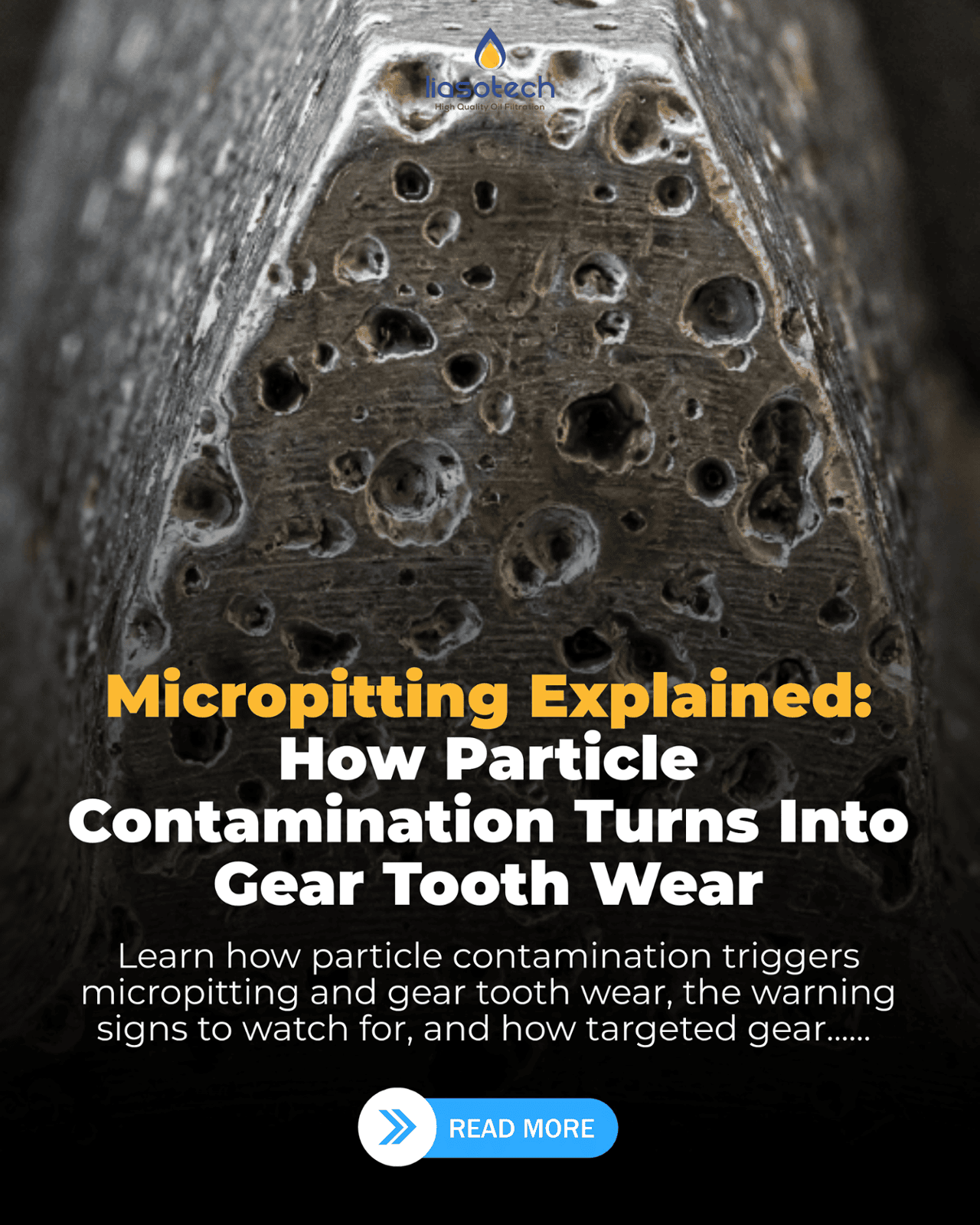
Micropitting is a surface fatigue failure that develops on the flanks of gear teeth, and less commonly on rolling element bearings, when the lubricant film separating two mating surfaces becomes too thin relative to the roughness of those surfaces. Rather than a single catastrophic event, it's the accumulation of thousands of microscopic fatigue cracks, each only a few microns deep, that eventually link together across the tooth surface.
Left untreated, isolated micropits coalesce into macropitting and spalling — visible craters that remove material faster than the gear was designed to tolerate, and that ultimately drive a gearbox toward premature replacement.
How Particle Contamination Drives It
Particle contamination doesn't cause micropitting on its own — it accelerates a mechanism that's already present in every gear mesh. In gearboxes running at moderate speeds under heavy load, common in steel rolling mills, cement kiln drives, and heavy plastics extrusion equipment, the elastohydrodynamic film between gear teeth is already thin, often only a few microns near the pitch line where sliding velocity drops close to zero.
Hard particles larger than that film thickness get trapped directly in the contact zone. Each pass dents and abrades the surface, concentrating stress at the particle's edges and initiating the fatigue cracks that grow into micropits.
Why particle size matters more than particle count alone: a gearbox can carry an acceptable total particle count and still be at risk if a disproportionate share of those particles sit in the size range close to the local film thickness — which is why trending ISO 4406 or NAS 1638 codes over time matters more than a single snapshot reading.
Why Gearboxes Are Especially Vulnerable
Three conditions make gear meshes more susceptible to particle-driven micropitting than many other lubricated components:
Thin film thickness at the pitch line, where rolling gives way to sliding
High specific loading concentrated along a narrow contact band
Surface roughness from hardening and grinding that never fully smooths out in service
High-viscosity gear oils are chosen specifically to maximize film thickness under these conditions, but viscosity alone can't compensate for particles larger than the film itself. That's why particle count — not just viscosity or additive package — is one of the most direct predictors of micropitting risk in a gearbox.
Early Warning Signs
Micropitting is difficult to catch by ear or eye until it's well established, which makes oil analysis the primary detection tool:
Rising particle counts, with ISO 4406 or NAS 1638 codes trending upward between sampling intervals
Ferrography showing fatigue-type wear particles rather than normal rubbing wear
A shift in oil color toward grey, or a fine metallic sheen
Gear mesh frequency sidebands appearing in vibration data
On visual inspection during a shutdown, a matte or frosted appearance across the tooth flank, sometimes called "grey staining"
None of these signs is exclusive to micropitting on its own, which is why a consistent trend line across sampling intervals is more reliable than any single reading.
Results and Benefits of Proper Gear Oil Filtration
- Lower, measurable cleanliness levels. Continuous or offline (kidney-loop) filtration brings gear oil down to, and holds it at, target ISO 4406 or NAS cleanliness codes, giving maintenance teams an objective, trackable number rather than a visual guess.
- Reduced unplanned downtime. Because micropitting develops silently over months, catching and reversing a contamination trend early avoids the abrupt, costly gearbox replacements that follow once surfaces have already progressed to macropitting or spalling.
How Targeted Filtration Addresses It
Standard inline filters are sized for flow and protect against gross contamination, but they typically miss the finer particle range most responsible for micropitting in tight film contacts. Offline gear oil filtration — circulating oil through a dedicated loop independent of the gearbox's operating pressure and flow — lets finer depth media work continuously without restricting lubrication to the gears themselves.
This is also where a common concern comes up: does filtration strip the extreme-pressure additives gear oils depend on? Modern EP additive packages are formulated to dissolve fully into the oil rather than sit as a separate phase, so depth filtration media generally passes them through untouched. The exception is a small number of solid-phase additives, such as molybdenum disulfide, which particle filtration removes alongside contaminants — a reason to confirm additive chemistry before filtering a solid-lubricant-fortified oil.
Liasotech's Gear Oil Filtration Systems (GOFS models) are built specifically for high-viscosity lubricants, running unattended in continuous offline loops to bring gearboxes in steel, cement, and heavy plastics operations down to target cleanliness levels without interrupting production.
Frequently Asked Questions
What's the difference between micropitting and macropitting (spalling)?
Micropitting is made up of fatigue cracks and pits typically under 20 microns deep, often invisible without magnification and showing up as a dulled or frosted surface. Macropitting, or spalling, is what happens when micropits link together and larger pieces of material break away, leaving visible craters that measurably reduce tooth strength.
Can gear oil filtration actually remove particles fine enough to prevent micropitting?
Yes, provided the filtration is matched to the particle size range relevant to the gearbox's film thickness. Depth media used in offline gear oil filtration systems is selected to capture the sub-10-micron particles that standard inline filters often pass through, which is the range most implicated in disrupting the lubricant film.
How often should gear oil be sampled to catch micropitting risk early?
For heavily loaded industrial gearboxes, monthly particle count and ferrography sampling is a reasonable baseline, with more frequent sampling justified for gearboxes with a history of contamination or operating in dusty environments. A consistent trend line matters more than any single result.