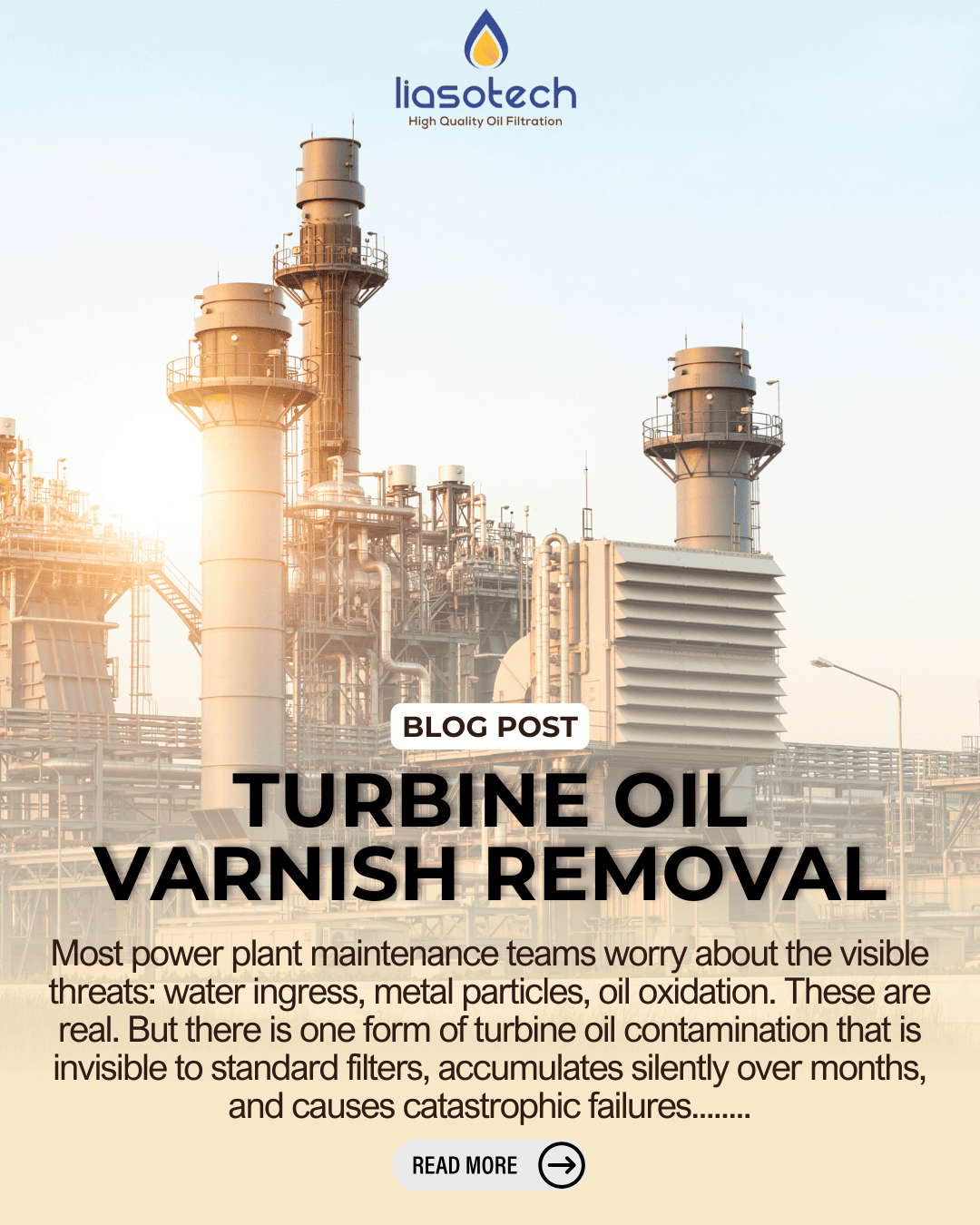
Most power plant maintenance teams worry about the visible threats: water ingress, metal particles, oil oxidation. These are real. But there is one form of turbine oil contamination that is invisible to standard filters, accumulates silently over months, and causes catastrophic failures without warning. That threat is turbine oil varnish.
Varnish does not look like a contaminant. It looks like a thin amber or brown coating on internal surfaces — servo valves, bearing housings, hydraulic control systems, oil coolers, and filter elements. By the time it is visible to the eye, the damage is already in progress.
This guide explains what turbine oil varnish is, what causes it, how to detect it early, and — critically — how to remove it from your system without shutting down your plant.
What Is Varnish in Turbine Oil?
Varnish is a soft, sticky or hard, lacquer-like deposit formed when oil degradation by-products polymerize and drop out of solution. It is not a particle in the traditional sense. Most varnish precursors are sub-micron in size — too small to be captured by conventional mechanical filters, which typically operate at 3 to 10 microns.
The deposits form on surfaces where oil temperature is highest: servo valve spools, bearing journals, oil cooler tubes, and lube oil headers. Over time, varnish builds up layer by layer. The consequences are severe:
Servo valve stiction and sluggish response — varnish restricts valve movement, leading to control instability or complete seizure.
Turbine bearing damage — varnish deposits reduce the oil film thickness that protects bearing surfaces, accelerating wear.
Filter plugging — varnish coats filter elements and collapses their effective micron rating, causing high differential pressure alarms and premature changeouts.
Oil cooler fouling — varnish on heat exchanger tubes reduces thermal efficiency, raising oil temperatures and accelerating further degradation.
Unplanned shutdowns — in steam and gas turbines, varnish-related control valve failure is a leading cause of forced outages.
Varnish is not a new problem. But as turbine oil formulations evolve and operating temperatures increase in combined-cycle and gas turbine plants, it is becoming more frequent — and more damaging.
What Causes Varnish in Turbine Oil Systems?
Understanding the cause is the first step to solving it. Varnish formation in turbine oil is not a single event. It is the end result of a degradation process that begins the day oil is put into service.
Oil Oxidation
All turbine oils oxidize over time. When turbine oil is exposed to heat, oxygen, and metal catalysts (from system components), it reacts to form polar degradation compounds — aldehydes, ketones, carboxylic acids, and hydroperoxides. These compounds are the direct precursors to varnish.
At normal operating temperatures, these by-products remain dissolved in the oil. But when oil temperature rises above approximately 60°C, or when the oil is stressed by micro-dieseling, cavitation, or air entrainment, these compounds can rapidly polymerize and fall out of solution — depositing as varnish on the coolest surface available, typically bearing housings and valve bodies.
Thermal Stress and Micro-Dieseling
Gas turbine lube oil systems operate under high pressures. When oil passes through tight clearances — servo valve orifices, bearing drain lines — dissolved air can be compressed rapidly and ignite locally. This is known as micro-dieseling. The localized temperature spike can reach hundreds of degrees Celsius, burning a small pocket of oil instantly and generating a concentrated burst of degradation products.
Water Contamination
Water in turbine oil is a catalyst for oxidation. Even small amounts — 200 to 500 ppm — dramatically accelerate the oxidation rate. Water promotes the hydrolysis of oil additives, particularly rust inhibitors and antioxidants, stripping the oil of its protective chemistry and leaving it far more vulnerable to thermal degradation and varnish formation.
Water enters turbine lube oil systems through steam seal leaks in steam turbines, condensation in reservoir headspaces, and cooling water leaks in oil coolers. In many plants, water is the primary trigger for varnish problems that appear months later.
Antioxidant Depletion
Fresh turbine oil contains antioxidant additives that neutralize free radicals and interrupt the oxidation chain reaction. As these additives are consumed — by heat, water, and metal contamination — the oil loses its ability to resist further degradation. Once the antioxidant package is depleted, the oil oxidizes rapidly and varnish formation accelerates.
This is why regular oil analysis — specifically measuring antioxidant levels alongside particle count and water content — is essential to predicting varnish risk before deposits appear.
System Design and Oil Age
Long oil residence times, large reservoir volumes with poor circulation, inadequate filtration, and extended oil change intervals all contribute to varnish accumulation. Many power plants operate turbine oil for 5 to 10 years or more — a duration that, without active contamination control, almost guarantees varnish problems.
How to Detect Varnish in Turbine Oil: Key Tests
Early detection is the difference between an oil treatment programme and an emergency shutdown. The following tests are used by turbine oil specialists to assess varnish risk and severity.
- Membrane Patch Colorimetry (MPC) is the most widely accepted test for soluble varnish precursors. Oil is passed through a 0.45-micron membrane patch; the colour of the patch is compared against a reference scale. An MPC value above 40 indicates high varnish risk. Above 60, varnish deposits are likely already present in the system.
- RULER (Remaining Useful Life Evaluation Routine) measures the remaining antioxidant concentration in the oil as a percentage of new oil. A reading below 25% signals that the oil's oxidation resistance is nearly exhausted and varnish formation is imminent.
- Acid Number (AN) measures organic acid content. Rising acid number indicates oxidation by-products accumulating in the oil — a reliable early warning of varnish risk.
- Particle Count and ISO Cleanliness Code — while conventional particle counting does not measure varnish directly (varnish particles are too small), a pattern of rising particle counts combined with rapidly-clogging filter elements is a strong indicator of varnish deposition and re-entrainment.
- Visual Inspection of drained filter elements, servo valve surfaces, and bearing housings provides direct evidence of existing deposits — though by the time varnish is visible, it has already affected system performance.
Why Standard Filtration Cannot Remove Turbine Oil Varnish
This is the critical point that many maintenance managers miss, and it is responsible for millions of rupees in avoidable turbine damage every year. Standard turbine oil filtration systems — whether depth filters, spin-on elements, or pressure line filters — are designed to capture solid particles. They work by mechanical interception: oil passes through a filter medium, and particles larger than the filter's rated micron size are trapped. Varnish does not work this way. Varnish precursors are dissolved in the oil at sub-micron scale. They pass straight through conventional 3-micron and 5-micron filters without being captured. Standard filtration removes the particles; it leaves the chemistry behind. This is why power plants can have clean ISO particle counts and still experience varnish-related valve stiction, bearing failures, and forced outages. The oil looks clean to a particle counter. It is not clean. Effective turbine oil varnish removal requires technology that targets dissolved degradation compounds and polar contaminants directly — technology that works at the molecular level, not the particle level.
How Liasotech Removes Varnish from Turbine Oil Systems
Liasotech manufactures two systems specifically suited to turbine oil varnish removal and long-term varnish prevention in power plants: the VDFS (Vacuum Dehydrator Filtration System) and the ELC (Electrostatic Oil Cleaning Machine). These systems are designed to work together as a complete contamination control solution — or independently depending on the plant's specific condition. Both can operate online, continuously, without requiring a turbine shutdown.
Liasotech VDFS — Vacuum Dehydrator Filtration System
The VDFS is Liasotech's high-performance vacuum dehydration and fine filtration system, designed specifically for continuous online operation on turbine lube oil and control oil systems.
- How it works: The VDFS draws oil from the turbine reservoir through a heating stage, where it is brought to a controlled elevated temperature. The heated oil then enters a vacuum chamber operating at very low absolute pressure. Under vacuum, dissolved water — including both free water and emulsified water — vaporizes and is removed through a condenser and auto-drain system. The dehydrated oil is then passed through absolute-rated microglass filter elements before being returned to the reservoir clean, dry, and particle-free.
- What makes it relevant to varnish: Water contamination is the primary accelerator of turbine oil oxidation and varnish formation. By continuously maintaining water content below 50 ppm — compared to the 200 to 500 ppm levels common in uncontrolled systems — the VDFS removes the single biggest driver of the degradation chemistry that produces varnish. A turbine lube oil system that stays dry does not oxidize at the same rate. Varnish precursors form more slowly. The antioxidant package lasts longer.
- Key VDFS specifications for turbine applications: Achieves water content as low as 50 ppm — well below the ISO threshold for turbine oil cleanliness. Achieves particle count of ISO 14/12/09 or NAS Class 3 using specially designed 3-micron absolute filters. Flow rates from 20 LPM to 100 LPM — sized to match turbine reservoir volume and required circulation rate. Operates 24 hours a day, 7 days a week, unattended — designed for continuous online duty. Automatic water drain valve eliminates manual intervention. High pressure trip switch and oil sample ports for condition monitoring integration. Suitable for turbine oil (all grades), hydraulic oil, lubrication oil, gear oil up to 680 cSt, and control fluids.
- The operational impact at power plants: When the VDFS is installed on a turbine lube oil circuit as a kidney-loop or bypass filtration system, it provides round-the-clock dehydration and fine filtration that the turbine's main system filters cannot deliver. Water is removed continuously rather than waiting for scheduled oil changes. Particle counts are maintained at target cleanliness levels regardless of operating conditions. The oil life is extended substantially — reducing oil change intervals and the risk of varnish that comes with extended-life oxidized oil.
Liasotech ELC — Electrostatic Oil Cleaning Machine
The ELC is Liasotech's electrostatic oil cleaner, and it is the technology that directly addresses what the VDFS cannot reach: the sub-micron polar varnish precursors dissolved in the oil.
- How it works: The ELC passes contaminated turbine oil through 18 successive static energy fields created by a high-voltage electrostatic generator inside the filter cartridge. These fields impart an electrical charge to contaminant particles — including polar degradation compounds, oxidation by-products, soft varnish precursors, and sub-micron particles that are too small for mechanical filters to capture. The charged contaminants are attracted to and bonded onto the millions of sharp edges within the collection media inside the cartridge, where they are permanently retained. This is fundamentally different from mechanical filtration. The ELC does not filter by size — it filters by charge. This means it can target and remove the exact compounds that cause varnish: the polar degradation products that pass straight through conventional filters.
- What makes it the right tool for varnish: Polar degradation compounds — the precursors of varnish deposits — carry an electrical charge. They are naturally attracted to charged surfaces, which is exactly why they deposit on servo valve spools and bearing housings in the first place. The ELC exploits this same property to extract them from the oil before they can deposit on system components. Regular ELC operation reduces the MPC (Membrane Patch Colorimetry) value of turbine oil — the direct measure of varnish risk. Plants using the ELC on continuous duty have reported varnish precursor levels dropping to safe ranges within weeks of installation, and sustained low MPC values over years of operation.
- Key ELC capabilities for turbine oil: Removes sub-micron contamination and polar varnish precursors that pass through conventional filters. Eliminates the need for conventional mechanical system filters in the secondary circuit, removing back-pressure and bypass flow risks. Extends turbine oil life significantly by removing oxidation by-products before they polymerize. Extends the life of turbine bearings, servo valves, and hydraulic control components. Reduces maintenance costs by lowering filter element consumption and extending service intervals. Operates continuously without shutting down the turbine — designed for 24/7 online duty. Supplied with a contamination test kit using the Millipore patch test method for on-site verification of oil cleanliness. Suitable for turbine oil, hydraulic oil, and lubrication oil systems.
- The ELC and existing varnish deposits: A plant with existing varnish deposits faces a more complex challenge. As the ELC removes varnish precursors from the oil, it shifts the chemical equilibrium of the system — the oil's ability to hold degradation products in solution increases. This causes some existing deposits to re-dissolve back into the oil, where the ELC can then capture them. This mechanism of gradual deposit removal is an additional benefit for plants dealing with varnish that has already formed on valve surfaces and bearing housings.
VDFS + ELC: A Complete Varnish Control Strategy for Power Plants
The most effective approach to turbine oil varnish removal combines both systems in a continuous online installation.
The VDFS handles the root cause — it removes water and fine particles continuously, slowing the oxidation rate and protecting the antioxidant package. By keeping the oil dry and clean, it dramatically reduces the rate at which new varnish precursors form.
The ELC handles the existing chemistry — it continuously removes polar degradation compounds and sub-micron varnish precursors from the oil in service, reducing MPC values and reversing the varnish risk trajectory.
Together, they address both prevention and remediation. The result is turbine oil that stays clean, dry, and varnish-free — without oil changes, without shutdowns, and without the costs of emergency maintenance.
This combination is particularly valuable in: Gas turbines and combined-cycle plants where operating temperatures are high and servo valve reliability is critical to plant output. Steam turbines with a history of water ingress through steam seals — where continuous dehydration is a necessity. Hydro power plants where large oil volumes and long oil residence times create ideal conditions for varnish accumulation. Plants with a history of forced outages attributed to valve stiction, high differential pressure alarms, or unexplained bearing wear. Plants considering oil extension programmes where life extension beyond normal intervals requires active contamination control.
Frequently Asked Questions: Turbine Oil Varnish Removal
Can varnish be removed without draining the turbine oil?
Yes. Both the Liasotech VDFS and ELC operate as online kidney-loop systems, processing turbine oil continuously while the turbine remains in service. Full drain-and-flush procedures are high-cost, high-risk, and only address existing deposits — they do not prevent recurrence. Online treatment with the VDFS and ELC is more effective and more economical.
How long does it take to see results?
With the ELC operating continuously, most plants see measurable reductions in MPC values within 4 to 8 weeks. With the combined VDFS and ELC installation, water content typically falls below 100 ppm within the first week. Full varnish risk mitigation depends on the initial severity of contamination and the turbine's operating conditions.
Is standard turbine oil filtration not enough?
Standard filtration manages particle contamination above 3 to 5 microns. It does not address water contamination, dissolved varnish precursors, or sub-micron polar degradation products. For most modern turbine systems operating at elevated temperatures and extended oil life, standard filtration alone is insufficient to prevent varnish formation.
How do we know if our turbine oil has a varnish problem?
The most reliable method is Membrane Patch Colorimetry (MPC) testing. Liasotech offers oil analysis and testing services — a baseline MPC test will confirm whether varnish risk is present and guide the appropriate treatment approach.
Can these systems be rented before purchase?
Yes. Liasotech offers filtration machine rental services, allowing plants to evaluate the VDFS and ELC on their own system before committing to a capital purchase.
The Cost of Ignoring Turbine Oil Varnish
For a power plant operating under schedule, the cost of a varnish-related forced outage is rarely just the repair bill. It includes lost generation revenue, regulatory penalties in dispatch-committed plants, emergency parts and labour, and the reputational impact of unplanned unavailability. A single servo valve seizure in a gas turbine can cause an outage lasting days. A bearing failure from varnish-induced oil film breakdown can cause weeks of downtime and six-figure repair costs. The cost of preventing these failures — through continuous online turbine oil varnish removal with the Liasotech VDFS and ELC — is a fraction of the cost of a single incident. The alternative to investment in contamination control is not "no cost." It is the cost being paid in a different form, at an unpredictable time, under the worst possible circumstances.
Conclusion: Turbine Oil Varnish Is Preventable
Varnish forms because turbine oil degrades, water accumulates, and the products of degradation cannot be removed by conventional filtration. That problem is well understood. The solution is equally clear: continuous online removal of water and varnish precursors, operating in parallel with the turbine, every hour it runs. Liasotech's VDFS and ELC systems are designed precisely for this application — for power plants that cannot afford unplanned outages, that operate turbine oil for extended intervals, and that need contamination control that works as hard as the turbines they protect. If your plant is experiencing high differential pressure alarms, servo valve sluggishness, unexplained bearing wear, or simply operating turbine oil that is overdue for analysis — the conversation starts with an oil test.
Liasotech Private Limited is an oil filtration equipment manufacturer based in Jamshedpur, India, serving power plants, steel plants, cement plants, and heavy industry across India. For enquiries about turbine oil varnish removal solutions, contact sales@liasotech.com or call +91 7643993545.